Mme.Chen Mingjian, Chargé d'affaires ad interim of the Chinese Embassy in Canada took an exclusive interview with OMNI Television
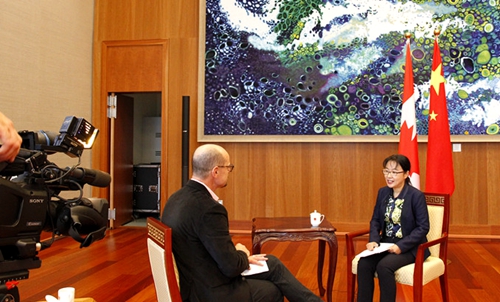
On September 3, Mme. Chen Mingjian, Chargé d'affaires ad interim of the Chinese Embassy in Canada took an exclusive interview with OMNI Television, elaborating China’s principal positions on China-US economic and trade frictions, China-Canada relations, and the situation in Hong Kong. The interview is recorded as follows:
Q: Currently, the China-US economic and trade frictions is upgrading and the Chinese side has resorted the newly announced tariffs of the US to WTO. What is the negative impact of the new tariffs on China?
Chen: It’s no doubt that the escalation of trade friction would bring negative impacts to China and the US’ economy in many ways, but the economic fundamentals that support a satisfactory long-term performance of China will stand unchanged with sufficient vitality, high resilience and enormous potentials of Chinese economy. In China, domestic consumption has become the major driving force for economic growth, giving China much leeway in formulating economic strategies.
China and the US are the two largest economies in the world. Maintaining a healthy and stable development of China-US relations serves fundamental interests of the two countries and the rest of the world. We must make it clear that it is the US who started the trade friction and China had to respond. The US unilaterally trade-bullied China with measures of extreme pressure. It went back on its words and promise in violation of consensuses between leaders of the two countries and principles of mutual respect, equality and mutual benefit. It escalated the trade friction repeatedly, damaging the rule-based multilateral trading system. These actions not only hurt the interests of China and the US, but also pose serious threats to world economic growth.
Q: President Donald Trump is unafraid of hurting his own domestic economy. Will this escalate the challenge of negotiation?
Chen: I believe that there must be someone who are afraid of domestic economic damage. This is why the words and deeds of the US government are raising oppositions from American people of insight and industry associations domestically, and deep concerns by leaders of various countries and international organizations. China always takes the view that no one is going to gain from a trade war. China does not want a trade war, but does not fear a trade war.
Q: Given latest moves by the White House, how can trade talks resume? Is there any hope? What is the next steps?
Chen: The only way out for trade friction is consultations and negotiations. Actually, China and the US have held 12 rounds of high-level consultations, and the working team of both sides have also maintained contact. I want to point out that striking a win-win deal of mutual benefits between China and US is expected by the world and will be in the interest of the two and the rest. China hopes that the US could remain clam, return to reason and meet us halfway to solve disputes through consultations in principles of mutual respect, equality and mutual benefit.
Q: Pompeo claims that Huawei extradition case is not a bargaining chip in trade dispute. Does this means a tougher stance of the US? Did you express your position to the US side?
Chen: This is a very good question. I believe it’s not difficult for you to find out who once said Ms. Meng Wanzhou’s incident could be used as a bargaining chip in the China-US trade talks, and now someone reversed that statement. I think you could ask them to clarify once you have an opportunity.
The Meng Wanzhou incident is by no means a purely judicial case, but a serious political incident plotted by the US. The US resorted state power to suppress a Chinese private high-tech company in an attempt to strangle their lawful and legitimate operations. Behind such moves are deep political intentions and manipulations. We have publicly expressed our position for many times, that is, release Ms. Meng Wanzhou immediately and allow her return back China safely.
Q: Some analysts believe that Canada has paid a very heavy price of the US led extradition case of Ms. Meng. Agricultural sector were suffered and two Canadian citizens were arrested. Is Beijing willing to have substantive talks with Ottawa about resolving these trade and political tensions?
Chen: The Canadian side has gravely violated the lawful rights and interests of Ms. Meng by arbitrary detention of her on groundless accusations. This has been firmly opposed by the Chinese side. The Meng Wanzhou incident is now the crux of the difficulties in China-Canada relations. As a result, the bilateral cooperation in various areas are seriously affected. The Chinese side feels very sad about this, but they are not caused by China.
In facts, the Chinese side always takes a practical attitude towards solving the difficult issues between our tow countries. We attach great importance to developing China-Canada relations and cherish the traditional friendship with the Canadian people. Since China and Canada established diplomatic relationship nearly 50 years ago, the bilateral ties have maintained a momentum of development. The two sides have achieved substantial results in exchanges and cooperation in economy and trade, people-to-people and cultural exchanges and sub-national cooperation etc. China has maintained the second largest trade partner of Canada for the past decade,and is now Canada’s second largest source country of overseas students and third largest source country of tourists. There are more than 110 flights traveling back and forth between the two countries every week. China and Canada also stayed in close communication and cooperation on regional and international issues such as climate change, and etc.
I believe that the Canadian side will make judgement based on its own interests rather than the others’. We once again urge the Canadian side to release Ms. Meng immediately and allow her to return to China safely. A sound China-Canada relationship not only serves the shared interests of both countries and two peoples, but the long-term development of our two countries.
Q: Did the protest movement surprise you in terms of number of weeks, and the resolve of Hong Kong residents over extradition bill?
Chen:If there is anything surprised me, that is, some people turn a blind eye to the obvious damage and injury caused by violence and unrest to the society and people of Hong Kong, but persist in hurting Hong Kong under the banner of so-called “democracy” and “freedom”.
The Hong Kong SAR government originally proposed to amend the Fugitive Offenders Ordinance so as to close the loopholes in Hong Kong’s existing legal system. However, some radical forces in Hong Kong, supported by anti-China forces, have been organizing demonstrations under the pretext of opposing the amendments. In order to maintain social stability, the Hong Kong government has decided to suspend the amendments. Even though the amendments are suspended, however, these radicals didn’t stopped, and they repeatedly resorted to violence. They stormed the Legislative Council, besieged the Liaison Office of the Central People’s Government, attacked the police station, and paralyzed the normal operation of the city, which had nothing to do with the amendments. The violence has grossly trampled on the rule of law and social order, severely undermined the stability and prosperity in Hong Kong and challenged the bottom line of the “One Country, Two Systems” principle. Their purpose is to seize the jurisdiction of Hong Kong, and to make the “One Country, Two Systems” principle exists only in name.
Q: Some foreign media reported that Chief Executive Carrie Lam once said privately that if there was a choice, she would choose to resign. In addition, there is widespread concern that if the situation continues to deteriorate, China may dispatch the PLA Garrison in Hong Kong. What measures can Beijing take to cool the current situation?
Chen: For Hong Kong, the most pressing task at the moment is to stop violence, end chaos and restore order in according with law. The Chinese central government will continue its staunch support for the SAR government led by Chief Executive Carrie Lam in governing Hong Kong according to law. We firmly support the Hong Kong police in strict law enforcement, and the judiciary body to punish the violent criminals according to law. We have full trust and confidence in the SAR Government and the Chief Executive in handling the situation and bringing it to an end in an orderly way. If the situation in Hong Kong deteriorates further which is beyond the control of the SAR government, the Chinese central government has enough solutions and enough power to quickly quell all kinds of situations that may arise. We are confident that we will win the battle to stop the violence and restore Hong Kong’s social order as soon as possible.
Q: Does this mean that Beijing still has confidence in the governing of Carrie Lam?
Chen: Yes, we do.