New Reform, New Development, New Opportunity
--Keynote Speech by Ambassador Zhang Junsai at the Canada-China Business Cooperation Forum
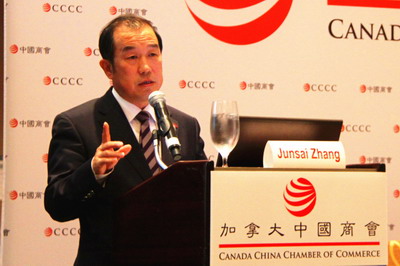
Mr. Wang Lijun, President of Canada China Chamber of Commerce (CCCC),
Loretta O'Connor, Executive Director of the Council of Confederation Secretariat,
Distinguished guests,
Ladies and gentlemen,
It gives me great pleasure to attend the Canada-China Business Cooperation Forum held by CCCC.
Since its establishment two years ago, CCCC has been playing an important role in facilitating communication and cooperation between the business communities from both countries, which has made significant contribution to the development of bilateral economic and trade cooperation.
I would like to take this opportunity to express my appreciation to all the members of CCCC for your persistent and valuable efforts.
I just returned to Canada from my annual leave in Beijing.
I could imagine that what you are most interested in is the blueprint of the comprehensively deepening reforms unveiled by The Third Plenary Session of the 18th Central Committee of the Communist Party of China, which is called "Reform 2.0" by Chinese media, and "the boldest reforms in decades" by foreign media.
It is widely believed that, just like the reform and opening-up policy adopted in 1978, this new reform agenda will have profound impact on China's economic and social development, and will provide enormous opportunities to the rest of the world.
Over the past 35 years, China has seen an average annual GDP growth of around 10%, and the livelihood of the Chinese people has improved remarkably.
However, China is also facing tough problems such as unbalanced, uncoordinated and unsustainable development, irrational industrial structure, environmental pollution and ecological deterioration, uncoordinated urban-rural and regional development, and inadequate social security network.
Meanwhile, China's reform has entered the deep water zone where the challenges of adjustment of major interests and improvement of systems and institutions in various fields must be met.
If these problems and challenges are not properly solved, China's further development will be hindered, and it will be difficult for us to stride over the middle-income trap and accomplish the goal of building a moderately prosperous society, and great rejuvenation of the Chinese nation.
We have no way out but to deepen the reform.
The Party meeting outlined the objective, direction and measures of deepening reforms of economic, political, cultural, social, ecological systems, and requested that all the proposed reform tasks should be accomplished by 2020.
We are determined to eliminate all institutional obstacles through comprehensively deepening reforms, so as to enhance economic and social vitality, improve efficiency of the government, promote social harmony and stability, democracy and the rule of law, vigorously improve people's livelihood and social security.
The Party meeting pointed out very clearly that economic reform is the key of the entire reform drive, and economic development remains the top priority.
This is based on China's national conditions. Till now, development is still the solution to all the problems in China.
So we have to emancipate and develop the productive forces, and enhance China's comprehensive strength and international competitiveness.
Meanwhile, economic reform will also create conditions for and inject impetus to reforms in other areas.
About deepening economic reform, I would like to highlight the followings aspects.
Firstly, keep a proper relationship between the market and government.
This is the core of China's economic reform. And the Party meeting stressed that we should leave the market playing the decisive role in allocating resources.
Since the reform and opening-up, China's economic reform has been focusing on adjusting the relationship between the market and government.
During a fairly long period of time, the allocation of resources in China was inefficient as our market system was far from mature.
As we carried out the economic reform step-by-step, and China moved from planned economy to planned commodity economy, and then to socialist market economy, the power of market was gradually released.
Now the conditions for the market to play the decisive role in allocating resources are in place.
At the same time, we will improve the role of government. The practice of modern economy has proven that government is indispensable in driving economic development.
Actually, many countries have come to realize the role of the visible hand of government in economy in their dealing with the recent international financial crisis.
The responsibility of the government is to maintain a stable macro-economy, improve public service, supervise the market, and keep market order.
The market and government have different roles and should complement each other.
As long as the market functions well, the government should not intervene. But once there is a market failure, the government shouldn't hesitate to step in.
We should give full play to the advantages of both the market and government.
Secondly, build a unified and open market system with orderly competition.
At present, the market mechanism in some economic sectors in China is not perfect.
To develop the socialist market economy, we must build a platform to allow the market to fully play its part, ensure fair competition, and the goods and factors of production to be traded equally.
So China will make market rules that are fair, open and transparent, and implement a unified system of market access, with market players of all kinds able to enter equally and legitimately into areas that are not on the negative list.
Actually, you may have noticed that the recently launched Shanghai Pilot Free Trade Zone already has a "negative list", which is one of the major changes introduced in that zone.
We will ensure that both the public economy and non-public economy can equally use factors of production, participate in market competition on an open, fair and equitable basis, and are given the same legal protection and supervision.
We will push ahead price reforms of water, oil and natural gas, electricity, transportation and telecommunication. Any price that can be determined by the market will be left to the market.
We will open up the financial market even wider, improve the market-oriented exchange rate formation mechanism for RMB, the Chinese currency, and speed up the interest rate liberalization and capital account convertibility.
At the same time, we must take precautions against any financial risk and effectively protect the safety of financial markets.
Thirdly, improve urban-rural integration system and gradually narrow the gap between urban and rural areas.
The imbalance between urban and rural development is one of the main challenge to China's economic and social development.
China's agricultural sector remains weak. There are obvious gaps in employment, income, infrastructure and public services between urban and rural areas. To build a moderately prosperous society, the most formidable and onerous task lies in the rural areas.
But on the other hand, urban-rural integration and urbanization is a major driving force of China's economy.
It also has the great potential to release domestic demand.
We will build new agribusiness systems and grant more property rights to farmers.
We will promote equitable exchanges of production factors and more balanced allocation of public resources between urban and rural areas.
We will coordinate urbanization and rural construction and allow more rural migrants to become city residents.
These measures are meant to grant farmers equal opportunities of participating in and benefiting from China's modernization drive.
Fourthly, develop a new open economic system.
With the economic globalization deepening, the domestic and international markets are now highly integrated.
To better make use of both domestic and international resources and markets, we must open up further to the outside, and at the same time strengthen domestic coordination.
We will widen market access for foreign investors, unify laws and regulations for domestic and foreign investors, and keep investment policy stable, transparent and predictable.
More efforts will be made to open up service sectors including finance, education, culture and health.
Investment restrictions in nursery, pension, architecture design, accounting and auditing, trade and logistics, and e-commerce will be eased.
And further liberalization will be achieved in general manufacturing.
Chinese enterprises and individuals will be encouraged to invest overseas and undertake contract and labor cooperation projects at their own risk.
We will speed up the building of Free Trade Area and strengthen mutually beneficial cooperation with other countries and regions.
We will make use the opportunities of reconfiguration of global industry to promote the development of trade, investment, technology and innovation in China's inland areas.
Ladies and gentlemen,
China-Canada relationship has been developing rapidly in recent years, and the bilateral cooperation in trade, investment, culture, education, technology, and tourism are fruitful.
According to Chinese statistics, in the first ten months of this year, our bilateral trade scored a year-on-year increase of 6.2% and reached 44.4 billion US dollars, while the Canadian exports to China stood at 18.8 billion US dollars, registering an increase of 11.4%.
Given that Canada's total exports decreased in the same period, the Chinese market is becoming obviously more important to Canada than ever.
China's new reform agenda will no doubt bring more opportunities for our economic cooperation.
The reform will facilitate China's transformation of development patterns and economic restructuring. China's growth will rely more on domestic demand and innovation. And the Chinese people in both urban and rural regions are getting richer.
It means that China's demands for energy, minerals, agri-food and high-tech products of Canada will keep growing. And our cooperation in strategic emerging industries will further expand.
China's further opening up of service sector is also good news for Canada's strong service industry. There is enormous potential to be tapped in our cooperation in this area.
Actually, investment opportunities in China's service sector have drawn the attention of worldwide.
From January to September this year, the FDI into China's service sector gained a year-on-year growth of 13.28% and reached 44.7 billion US dollars, accounting for more than half of China's total inbound FDI in the same period.
As China's market rules and regulations become more open, fair and transparent, it will provide more opportunities for Canadian investors to do business in China.
We also welcome Canadian enterprises to take part in the development and opening-up of China's inland provinces and regions.
This October, many foreign leaders, including Canadian Governor General David Johnston, visited Chengdu, the Capital of Sichuan Province in the western part of China, and attended the Western China International Fair.
It shows that the booming western part of China is attracting worldwide focus.
In addition, with the Chinese enterprises accelerating the pace of "going global", Canada also faces the opportunity to further diversify its sources of inbound FDI.
It's estimated that in the next 5 years, China's outbound FDI will reach 500 billion US dollars.
I hope more and more Chinese investors will come to Canada.
Ladies and gentlemen,
As an old Chinese saying goes, when the spring comes, ducks are the first to tell the warmth of the river.
The business communities from our two countries are the most active players in our bilateral economic cooperation.
Nobody can tell the new opportunities for cooperation more quickly and precisely than you do.
I hope that you could make full use of the platform set up by CCCC to seek business opportunities together, and offer your valuable insights on China-Canada economic cooperation.
I am convinced that with the joint efforts by the Governments and business communities of our two countries, our economic cooperation will make further headway and bring more benefits to our two peoples.
Finally, please allow me to wish again every success for today's forum.
Thank you all.